
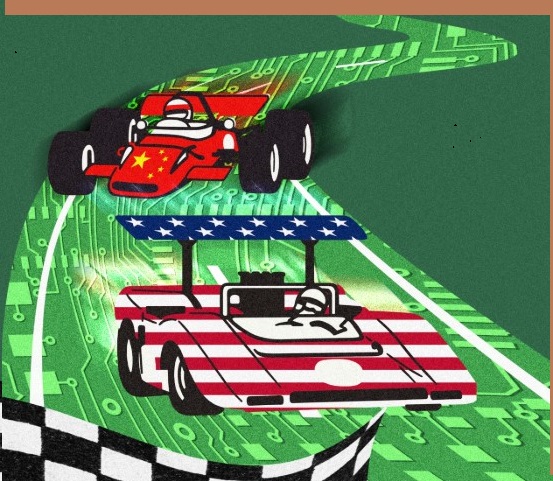
China Quietly Gains Ground on the United States
For much of the past decade, the global artificial intelligence (AI) landscape has been dominated by American firms—OpenAI, Google, Meta, Anthropic—who have set the pace in research, model performance, and market influence. But 2025 is telling a new story. China is no longer playing catch-up. It is expanding outward, aggressively and strategically, using open-source AI as a lever to gain global ground.
China ’s AI Push: From Local to Global
Chinese technology leaders such as Alibaba, Tencent, and Baidu, alongside emerging startups like DeepSeek, Moonshot AI, and Zhipu.ai, have accelerated their efforts to export AI systems abroad. Their approach is notably different from the U.S. model.
Where American firms are cautious, centralized, and increasingly closed-source, China is opting for scale, accessibility, and openness. Their models are cheaper to deploy, less resource-intensive, and multilingual. This makes them particularly attractive to markets in Africa, Southeast Asia, Latin America, and parts of Eastern Europe—regions where access to models like GPT-4 or Gemini is often restricted, unaffordable, or logistically impractical.
China ’s Strategy is not just technological—it is geopolitical.
Open-Source as Infrastructure and Influence
Chinese AI companies are flooding the market with open-source large language models (LLMs) that compete with or closely trail Western benchmarks. Models like DeepSeek-V2 and Baichuan are now widely accessible to developers globally, requiring significantly less computing power to run while offering respectable performance.
These models are not only being adopted because of performance; they are being chosen because of availability. They bypass Western API restrictions, offer flexible licensing, and, critically, support regional languages and locally relevant use cases. In effect, China is building goodwill and influence by giving the Global South what the U.S. has not: open, powerful, accessible AI tools.
Why the U.S. May Be Losing Ground
U.S.-based firms still hold the lead in AI innovation. OpenAI’s GPT-4o and Google’s Gemini 1.5 Pro are technically ahead of most international models. However, that advantage is narrowing in terms of global adoption. Export restrictions on advanced chips, payment system limitations, and a pullback from open-source releases are slowing Western AI diffusion.
Meanwhile, developers in Lagos, Jakarta, and São Paulo are increasingly choosing open Chinese models—not out of loyalty, but out of pragmatism.
A Multipolar AI Ecosystem
The implications are clear: we are moving toward a multipolar AI world. Innovation may still be centered in the United States, but deployment and adoption are rapidly decentralizing. China’s approach—grounded in open access, speed, and global outreach—is reshaping where and how AI tools are built and used.
If current trends hold, we may see the next wave of influential AI applications being built not in Silicon Valley, but in Nairobi, Ho Chi Minh City, and Riyadh—on top of Chinese infrastructure.
What’s at Stake
The AI race is no longer a purely technical contest. It is a competition over platforms, ecosystems, and influence. And in this new phase, China is proving adept at moving quickly, thinking globally, and offering the tools that millions of developers and institutions outside the West are ready to use today.
